
Separation and Divorce
Married in India, Separating in Surrey: Divorce, Annulment and Property in Both Countries
Mandy Shergill17 November 20268 min read
Many Surrey families married in India and still have property, parents or a spouse there. Here is how a BC separation works when your life spans both countries.
The short answer
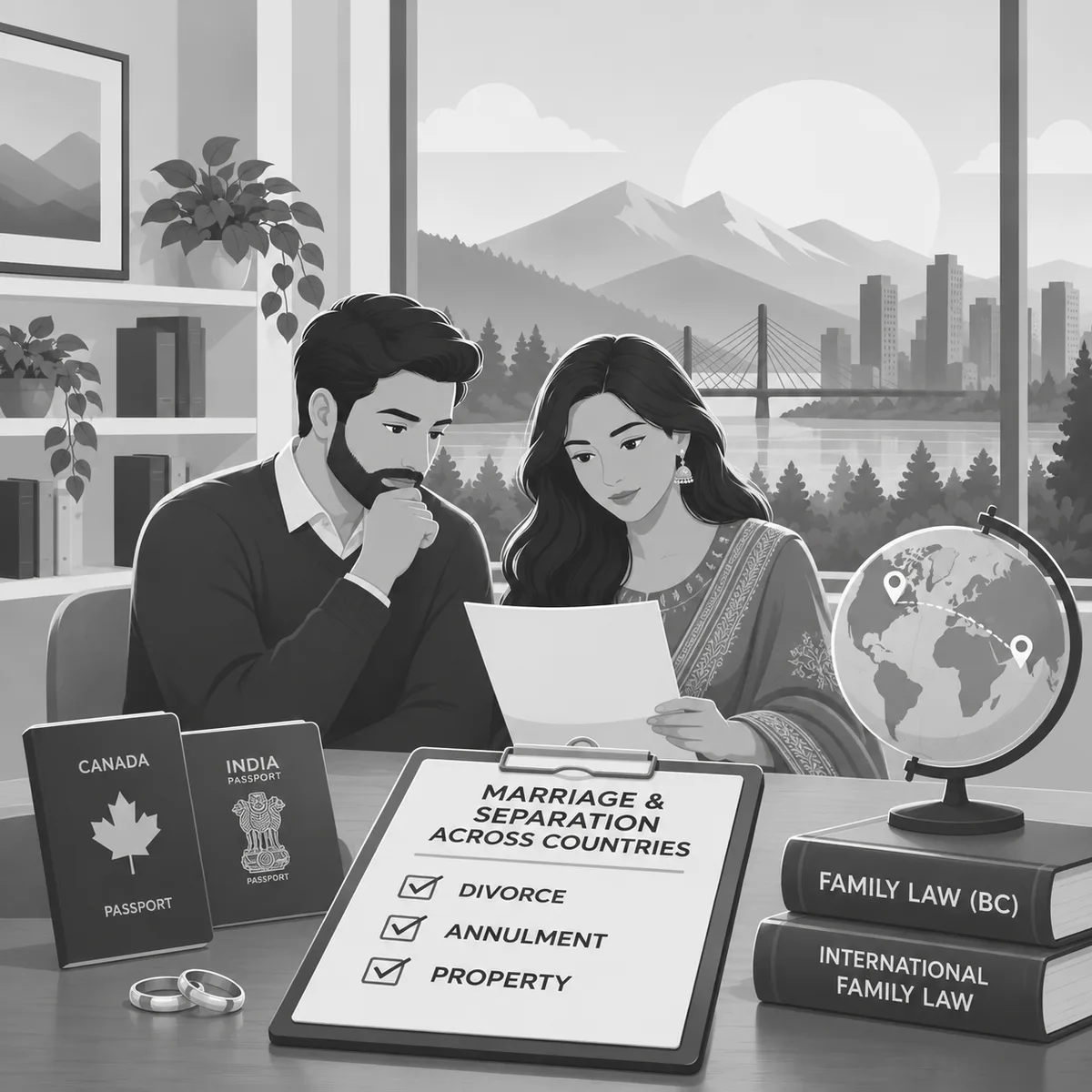
If you married in India and now live in Surrey, you can usually get divorced in BC once either spouse has been habitually resident in BC for at least one year (Divorce Act, section 3). A marriage that was valid in India is generally recognized in Canada, so divorce, not annulment, is the usual route.
Property in India counts too. A BC court can take land, homes and accounts in India into account when dividing family property, even where it cannot change title in India directly. The harder questions are usually practical: proving what is in India, dealing with a parallel case started there, and protecting children who travel between the two countries.
Is a marriage registered in India valid in Canada?
Generally yes. Canadian courts look at whether the marriage was valid under the law of the place it was performed, so a marriage that met the requirements of Indian law, whether a Hindu, Sikh, Muslim, Christian or civil marriage, is usually treated as valid here.
What you will need to prove it:
- A marriage certificate or registration, with a certified English translation if it is in Punjabi, Hindi or another language.
- Evidence of the ceremony if the marriage was never registered, such as photographs, invitations or statements from people who attended. Under some Indian laws a marriage is valid once the ceremonies are performed, and registration is proof rather than a requirement.
- Any earlier divorce papers if either spouse was married before.
Even if a marriage turns out not to be valid, couples who lived together in a marriage-like relationship in BC for at least two years are spouses under the Family Law Act, with the same rights to property division and spousal support.
Getting divorced in BC, and divorces granted in India
A BC divorce is granted by the Supreme Court of British Columbia. The court has jurisdiction if either spouse has been habitually resident in BC for at least one year immediately before the case starts. The other spouse can live in India; they are served there.
The most common ground is living separate and apart for one year. The marriage certificate from India, translated, is filed with the application. See our divorce lawyer in Surrey page for the steps and timeline.
What if your spouse files for divorce in India? Canada recognizes a foreign divorce if either spouse was habitually resident in that country for at least one year before the proceedings started (Divorce Act, section 22), and other recognition rules can also apply. If both of you live in Surrey, an Indian divorce may not meet that test. Recognition can also be refused where a spouse was given no real notice of the case.
If you learn of a case in India, act quickly. Starting your own BC case, and raising property and support here, can matter for which court decides what. An Indian divorce also does not necessarily settle property or support in BC, and BC deadlines for those claims can run from the date of a divorce.
When annulment applies instead of divorce
An annulment is a declaration that a marriage was never legally valid. The grounds are narrow, and only the Supreme Court of British Columbia can grant one. Cases involving marriages in India usually turn on one of these:
| Situation | Likely route |
|---|---|
| One spouse was still married to someone else at the time of the wedding | Annulment: the marriage was void from the start |
| A spouse did not genuinely consent, for example because of serious threats or force | Possibly annulment, depending on the evidence |
| The marriage was never consummated because of an inability to do so | Possibly annulment |
| The marriage was short, or ended soon after arrival in Canada | Divorce: a short marriage is not a ground for annulment |
| One spouse married mainly to immigrate | Usually divorce: a marriage entered for immigration is not automatically void |
An annulment does not erase property or support claims. A spouse in an annulled marriage can still have rights under the Family Law Act, particularly if the couple lived together. Our annulment lawyer in Surrey page explains the grounds in more detail.
Dividing property in both countries
Family property under the BC Family Law Act includes property anywhere in the world, not just in BC. Where the couple's last shared home was in Surrey, BC law usually governs the division.
What that means for property in India:
- It must be disclosed. Land, a home, a share in a family business, bank accounts and gold all belong in financial disclosure, supported by records such as sale deeds, land records and bank statements, with certified translations.
- A BC court can compensate instead of transferring. Where it cannot practically change title in India, the court can order one spouse to pay the other, or give the other spouse more of the property in BC (section 109).
- Excluded property can be reached in some cases. If family property outside BC cannot practically be divided, the court can divide excluded property instead (section 96).
- Inherited or ancestral property is generally excluded property, but any increase in its value during the relationship is family property and is shared.
Interests in joint family property held under Indian law can be hard to value, and an Indian court may not enforce a BC order directly. That is why early disclosure, and a negotiated agreement both spouses will follow, usually works better than relying on a court order alone. For gold, jewellery and wedding gifts, see dowry and wedding gifts in a BC divorce.
Children, travel and support across borders
Parenting decisions for a child who lives in Surrey are made in BC, based on the child's best interests. The cross-border issues come up when a child travels, or when a parent wants to move.
- Travel to India. India is not a party to the Hague Convention on international child abduction (U.S. Department of State), so there is no treaty process to bring a child back if they are kept there. Parenting agreements often set clear terms for trips: written consent, dates, return tickets and contact while away.
- Protecting against removal. Where there is a real risk a child will not return, a BC court can prohibit removal from a specified area, require security, or order passports to be surrendered (Family Law Act, section 64).
- Moving with a child. A guardian planning a relocation that would significantly affect the child's relationship with the other guardian must give at least 60 days' written notice (section 66).
- Support from a spouse in India. Child and spousal support can be ordered in BC, but collecting from a spouse who lives in India can be difficult. A lump sum, security against BC property, or an offset in the property division may be worth negotiating.
Family visits and weddings in India are a normal part of life for many Surrey families. Clear travel terms agreed early prevent most of these disputes.
Help in English, Punjabi and Hindi
Separating across two countries is easier to work through in the language you think in. At Shergill Law in South Surrey, Mandy Shergill advises in English, Punjabi and Hindi, and Ramneet Sidhu in English and Punjabi.
We help with:
- BC divorces where the marriage took place in India, including translating and filing the marriage record.
- Responding to a divorce case started in India, and advising on whether it will be recognized here.
- Annulment where the grounds genuinely apply.
- Property division involving land, homes, accounts and gold in India.
- Parenting plans with clear terms for travel to India.
We also act for clients who live in India and have a family law matter in BC. Our rates are affordable and explained at a consultation. Learn more on our Punjabi-speaking family lawyer and Hindi-speaking family lawyer pages, or call (604) 773-4392.
Frequently asked questions
Can I get divorced in BC if we married in India?
Yes, if the marriage was valid in India and either spouse has been habitually resident in BC for at least one year before the divorce case starts. The most common ground is one year of separation.
Is a divorce from India valid in Canada?
It is generally recognized if either spouse was habitually resident in India for at least one year before the Indian proceedings started. It may not be recognized if both spouses lived in Canada, or if one spouse had no real notice of the case.
Do I need to translate my Indian marriage certificate?
Yes. A marriage certificate or registration that is not in English must be filed with a certified English translation.
Can a BC court divide property in India?
It can take property in India into account. Where it cannot directly change title there, it can order compensation or give the other spouse more of the property in BC instead.
My marriage ended soon after I came to Canada. Can I get an annulment?
Usually not on that basis alone. A short marriage, or one entered mainly for immigration, is not automatically void. Divorce is usually the route, and property and support rights still apply.
Can I take my child to India after separation?
Usually with the other guardian's written consent or a court order. Because India is not a party to the Hague child abduction convention, agreements and courts often set clear travel terms.
Can my spouse who lives in India be served in a BC case?
Yes. A spouse living outside Canada can be served there, and the BC case can proceed if they do not respond.
This article is general information about family law in British Columbia. It is not legal advice for your situation. Speak with a lawyer about the facts of your own matter.