
Property and Debt
Who Keeps the House After Separation in BC? Buyouts, Refinancing and Selling
Mandy Shergill13 November 20268 min read
For most separating couples in the Lower Mainland, the family home is the largest asset and the largest debt. Here is how BC decides who keeps it, and what each option costs.
The short answer
Neither spouse automatically keeps the house in BC. If the home is family property, each spouse is entitled to half its value on separation under section 81 of the Family Law Act, whoever is on title and whoever paid the mortgage.
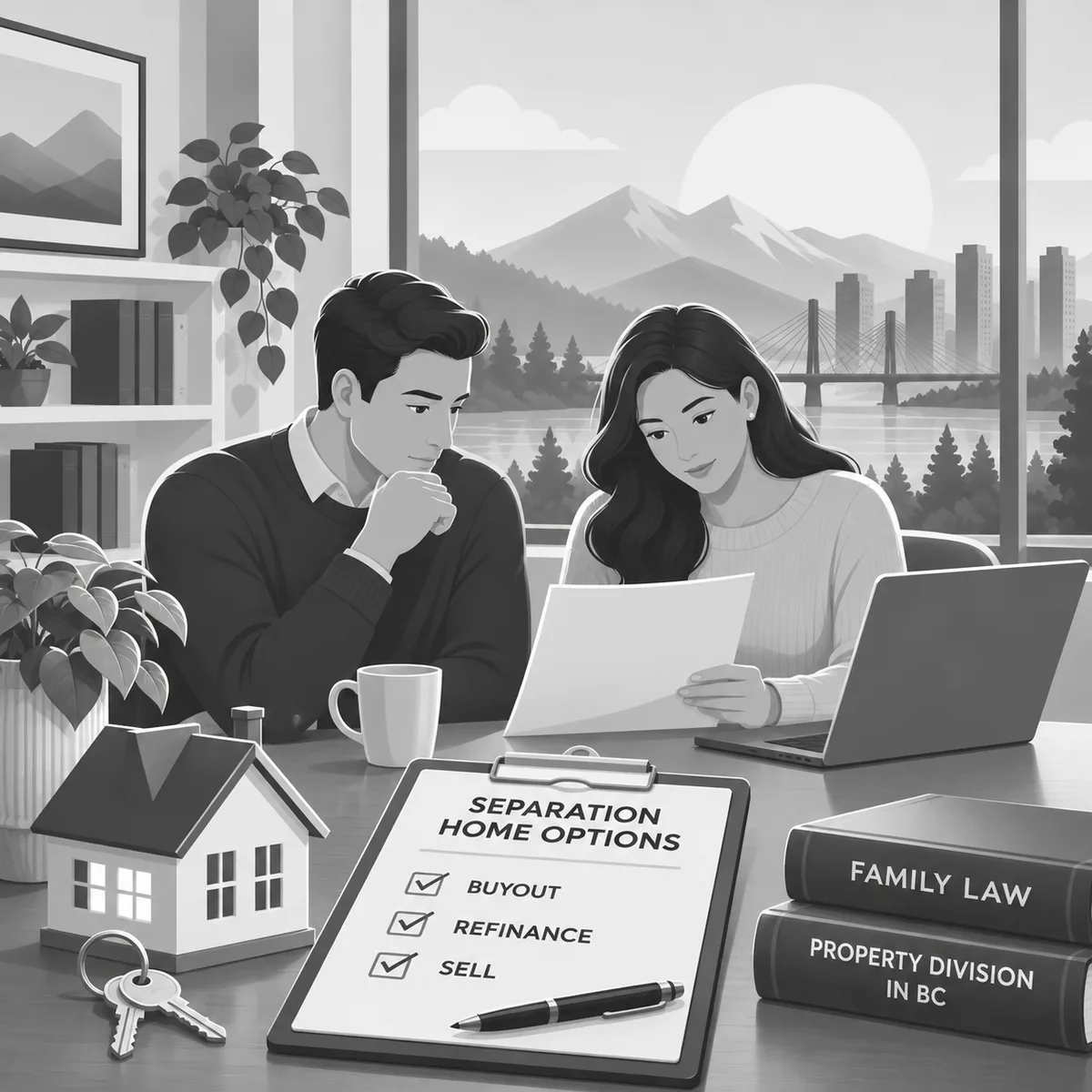
That leaves three practical options: one spouse buys the other out, one spouse refinances the mortgage into their own name to fund that buyout, or the home is sold and the equity split. Which one works depends mostly on whether the spouse who wants to stay can qualify for the mortgage alone.
First question: how much of the house is family property?
Before deciding who keeps the home, you need to know what each spouse is actually entitled to. Under the Family Law Act:
- A home bought during the relationship is family property, split equally, regardless of whose name is on title (sections 81 and 84).
- A home one spouse owned before the relationship is excluded property, but the increase in its value during the relationship is family property and is shared (sections 84(2)(g) and 85).
- Money from an inheritance or a gift from family used toward the home can be excluded, but the spouse claiming the exclusion must prove it with records (section 85(2)).
- The value is set at the date of the agreement or the hearing, not the date of separation (section 87). If the market moves while you negotiate, so does each share.
The mortgage and any home equity line are family debt, shared the same way. For a deeper look at excluded property and tracing, see how property is divided in BC after separation.
Buyout, refinance or sell: how the options compare
These are the usual options, and some families combine them.
| Option | How it works | Works best when | Watch for |
|---|---|---|---|
| Buyout using other assets | The spouse keeping the home gives up an equal value of other family property, such as RRSPs, savings or a pension share | There are enough other assets to balance the home | The departing spouse is still on the mortgage unless the lender releases them |
| Refinance and buy out | The spouse keeping the home takes a new mortgage in their own name and pays the other their share of the equity | That spouse can qualify for the mortgage alone | Qualifying on one income, especially with Lower Mainland home prices |
| Sell | The home is sold and the net proceeds are divided under the agreement | Neither can afford it alone, or both want a clean break | Agreeing on a listing price, a realtor and who lives there until it sells |
| Delay the sale | Both stay on title, and the home is sold at a set future date, such as when the youngest child finishes school | Stability for children matters most and both can carry the costs | Who pays the mortgage, taxes and repairs in the meantime |
A transfer of title between spouses under a written separation agreement or a court order under the Family Law Act is exempt from BC property transfer tax (Government of BC, exemption code 15). Transferring title before the agreement is signed can cost you that exemption.
How a buyout is calculated
A buyout pays the departing spouse half the home's equity: its current value minus the mortgage and any other debt secured against it, adjusted for any excluded property.
Example. A Surrey townhouse bought together during the relationship is appraised at $1,200,000, with a $500,000 mortgage.
| Step | Amount |
|---|---|
| Appraised value | $1,200,000 |
| Less mortgage | $500,000 |
| Equity | $700,000 |
| Each spouse's half | $350,000 |
| New mortgage the remaining spouse needs to refinance and pay out the other | about $850,000, plus any prepayment penalty and legal costs |
Three adjustments often change the number:
- Excluded property. If one spouse put in a down payment from before the relationship, or from an inheritance, that amount may come off the top before the equity is split.
- Tax. Offsetting the home against RRSPs is not dollar for dollar, because RRSP money is taxed when withdrawn and home equity usually is not. A fair trade adjusts for that.
- Selling costs. Spouses sometimes agree to deduct notional realtor fees from the value, since the departing spouse avoids them. That is a negotiating point, not a rule.
An independent appraisal agreed by both spouses is usually the cheapest way to avoid arguing about value.
Who lives in the house until it is decided?
Until there is an agreement or order, both spouses usually have a right to stay. Three points come up in almost every case:
- Moving out does not give up your share. Your entitlement to half the family property comes from the Family Law Act, not from living in the home.
- A court can grant one spouse exclusive occupation of the family residence for a set period, and can postpone a sale while that order is in place (section 90). The order does not change who owns the home.
- Keep paying the mortgage, taxes and insurance. Debt taken on after separation to maintain family property is family debt (section 86), and who paid what is usually accounted for in the final division.
If you are not safe at home, the rules are different. A protection order can restrict a family member's access to the home, and Provincial Court can make one without a property claim. See protection orders and safety planning in BC.
Protecting the home while you negotiate
The biggest risk is the spouse on title selling, remortgaging or borrowing against the home before the division is settled. BC law gives you several ways to prevent that.
| Tool | What it does | When to use it |
|---|---|---|
| Entry under the Land (Spouse Protection) Act | Registers your interest against the family home so it cannot be dealt with without notice to you (Family Law Act, section 90(5)) | Early, especially if the home is only in your spouse's name |
| Certificate of pending litigation | Registered on title once a property claim is filed in court, warning buyers and lenders of your claim | When negotiations break down and a claim is started |
| Order restraining disposal | The Supreme Court must restrain a spouse from disposing of property at issue unless that spouse shows your claim will not be harmed (section 91) | If you have reason to think the home or its equity is at risk |
| Freeze joint credit | Ask the lender to freeze any joint home equity line so neither spouse can draw on it | As soon as you separate |
| Notice of agreement | Once a written property agreement is signed, it can be registered on title so the home cannot be sold or mortgaged without both signatures (section 99) | After you sign, until the transfer or sale is complete |
Remember the lender is not bound by your agreement. Until the mortgage is refinanced or paid out, both borrowers stay liable to the bank, whatever your agreement says (section 97(3)). For more on that, see our page on debt division in Surrey.
Help with the family home in Surrey
The family home is usually the largest asset and the largest debt in a separation, and the decision about it shapes the rest of the settlement. At Shergill Law, we help Surrey clients:
- Work out what each spouse is entitled to, including excluded property from before the relationship, inheritances and gifts from family.
- Negotiate a buyout, sale or delayed sale, with terms that take a name off the mortgage rather than relying on a promise.
- Protect the home with title registrations or court orders while terms are agreed.
- Document the transfer in a separation agreement, so the property transfer tax exemption applies.
We work with appraisers, mortgage brokers and notaries to get the transfer done, and advice is available in English, Punjabi and Hindi. Our rates are affordable and explained at a consultation. Learn more about our property division lawyers in Surrey, or call (604) 773-4392.
Frequently asked questions
Who gets the house in a separation in BC?
Neither spouse automatically. If the home is family property, each spouse is entitled to half its value, and the couple decides, or a court orders, whether one spouse buys the other out or the home is sold.
Do I lose my share of the house if I move out?
No. Your entitlement to half the family property comes from the Family Law Act, not from living in the home.
Does it matter whose name is on title?
Not for dividing family property. Each spouse is entitled to half, whoever is on title. Title matters for practical steps, such as protecting the home from being sold.
Is the house split 50/50 if one of us owned it before the relationship?
Not fully. The value it had when the relationship began is generally excluded and stays with the owner. The increase in value during the relationship is family property and is shared.
Do I pay property transfer tax if my spouse transfers the house to me?
Not if the transfer is made under a written separation agreement or a court order under the Family Law Act. That transfer is exempt from BC property transfer tax.
Can my spouse sell the house without my consent?
If you are not on title, it is possible, which is why spouses often register an entry under the Land (Spouse Protection) Act or ask the court for an order restraining disposal.
What date is used to value the house?
The date of the agreement or the court hearing, not the date of separation. If the market rises or falls while you negotiate, each spouse's share rises or falls with it.
This article is general information about family law in British Columbia. It is not legal advice for your situation. Speak with a lawyer about the facts of your own matter.